

Exclusive interview with Oksana Mitrofanova,
Ukrainian academic and researcher.

Alain Boinet
Oksana Mitrofanova, thank you for this interview. Could you introduce yourself for our readers?
Oksana Mitrofanova
Hello, I’m a Ukrainian political scientist who has taken refuge in France. I am a senior researcher at the Institute of World History of the Ukrainian National Academy of Sciences in Kyiv, a teacher-researcher hosted as part of the national PAUSE programme for exiled researchers at the Institut national des langues et civilisations orientales (INALCO Paris) from May 2022 to August 2024, and the author of the book “France-Ukraine. Une histoire des relations diplomatiques et militaires. 1991-2023” (Fondation Maison des Sciences de l’Homme, 2024). All my professional life I have worked at the Ukrainian National Academy of Sciences (the counterpart of the National Centre for Scientific Research) and I specialise in French and Ukrainian foreign and security policy and Franco-Ukrainian relations.
I have often been a visiting lecturer at the University of Paris-Panthéon-Assas, three times a senior visiting researcher at the Maison des Sciences de l’Homme, Paris, and a visiting researcher at the Marie Curie-Sklodowska University, Lublin, Poland. With a doctorate in political science, I am the author of over 100 publications and analytical notes for the Ministry of Defence, the Ukrainian Ministry of Foreign Affairs and the Ukrainian Parliament, and a speaker at international conferences in Budapest, Indianapolis, Kyiv, Lisbon, Lviv, Paris and Warsaw. My mother tongues are Ukrainian and Russian, but I am also fluent in English, French and Polish. I regularly appear on LCI, France 24 and the Ukrainian channel Pryamyi, and have published articles in Le Monde and Libération.
AB
Following Russia’s aggression against Ukraine on 24 February 2022, the people of your country have had to contend with the effects of war in all its forms for over two years. What are the consequences for the population?
OM
This is a complex question. We can talk about the immediate results of the war in Ukraine when, on a sunny summer’s day, missiles and hovering aerial bombs kill my compatriots and destroy critical infrastructure and residential buildings, but we can also talk about the global consequences such as the drop in GDP, the “demographic hole” or post-traumatic stress disorders in a significant number of not only military personnel but also civilians.

The fundamental consequence of the war is the destruction of the way of life of Ukrainians: their families, their homes, their destinies; exile, misery, the loss of work and social ties; an appalling psychological state due to the devastating daily bombardments and the loss of loved ones, relatives, friends; life for millions of us under occupation and even in the ordeal of deportation. What gnaws at us is the uncertainty of existence. After all, even the next hour, indeed the current minute, could be our last…
In addition to the losses suffered by the Ukrainians themselves, there has been considerable damage to the state: destruction of critical infrastructure, deterioration of housing stock; theft of fertile land, destruction of educational and health facilities; environmental crisis. To cope with this situation, the state is forced to take unpopular decisions such as raising taxes and mobilising men for the front. All this represents a double burden for Ukrainian citizens. And all this is happening in 21st century Europe!
In June 2024, the losses incurred by Ukraine as a result of the war amounted to almost 500 billion dollars. This is according to the joint communiqué issued by the G7 countries after the summit in Italy and the estimates of the World Bank.
The amount of direct damage caused to Ukraine’s infrastructure alone during the war (for example, the explosion of the Kakhovskaya hydroelectric power station triggered by Russia on 6 June 2023) reached almost 155 billion dollars in January 2024. And let’s not forget that some of the infrastructure critical to the Ukrainian economy is currently under Russian control, such as Europe’s largest nuclear power station, Zaporijjia.
Russia must pay for the destruction of Ukraine and the death of Ukrainians. The efforts of the international community should be aimed at forcing the aggressor country to pay substantial reparations. A transparent compensation mechanism is needed. We therefore welcome the G7 leaders’ decision that Russian assets will remain frozen until Russia ends its war against Ukraine and pays for the damage it has caused. These funds can then be transferred to Ukraine to restore the national economy and social life of our country.
The scale of the sanctions against Russia should also be increased in order to limit the income that the Russian state derives from its war. Without such measures, the European and global economies would also be at risk of themselves facing the consequences of the war in Ukraine in the more or less long term.
Concrete stories:
I wrote part of the first chapter of my book in December 2022 in Kyiv in the dark, with no electricity and the sound of explosions. When I’m in Ukraine, I don’t come into the shelter in the corridor of the building and I hear all the explosions and see the smoke from the bombing. Russian roulette ? Will we be killed or not during this attack ?

My 70-year-old neighbour was at her parents’ house in the Soumy region working in the vegetable garden when she was seriously injured by a Russian Grad missile, resulting in several operations and an immobilised arm. A woman with whom I studied at the history faculty of Kyiv’s Shevchenko University lost her husband and brother. A Ukrainian researcher of my age, a PAUSE prizewinner, has just written to me saying that her husband, a Ukrainian soldier, has been killed and she will not be able to recover his body from the combat zone. I don’t know what to say to her.
AB
In your book, you quote a French teacher who was in Kiev at the time of the Russian attack, Julien Plouchart. He told you that he had sensed that the Ukrainian population was beginning to believe that the existence of the nation was intimately linked to the fate of the army. Can you tell us more about this and where do things stand today ?
OM
Since the early days of the war, the armed forces have always been associated with the protection of the Ukrainian people as well as national sovereignty and territorial integrity. The fact that in the third year of the war against an enemy many times superior in terms of territory, manpower and weapons, Ukraine is not only standing on its own two feet but is also developing and preparing to join the European Union (EU) bears witness to the deep conviction of ordinary Ukrainians in the rightness of this historic and geopolitical choice and in their confidence in the forces of the Ukrainian army.
Many Ukrainians have relatives, friends and acquaintances who are currently fighting in the armed forces. Under such conditions, it is impossible to speak of any disintegration of the army, still less of a widespread desire on the part of Ukrainian citizens to shirk their duty to protect their homeland in danger.
At the start of the war in 2022, the level of confidence in the armed forces was between 94% and 96%, depending on the survey. In December 2023, the armed forces were the institution in which Ukrainians had the most confidence, with 94% in favour.

The general attitude towards the armed forces remained unchanged in the first half of 2024. At the end of March, according to a survey conducted by the Razumkov Centre, 96% of respondents had confidence in the Ukrainian army.
This level of support is not a sign of the advanced militarisation of Ukrainian society, unlike Russian society. Rather, it is a tribute to the glorious historical past of the Cossacks, who have always defended Ukrainian land against invasion, as well as to Kyiv’s heroic resistance to the Mongol invasion in the days of medieval Rus. Moreover, the war started by Russia is currently associated with the Mongol invasion.
Ukrainian resistance is rooted in a specific mental universe. In our resistance to what we see as Evil and Darkness, we are following in the footsteps of our ancestors.
AB
Western Europe has lived in peace since the end of the Second World War. Eastern Europe lived for a long time under the totalitarian regime of the Soviet Union, from which it freed itself almost 25 years ago. Today, Ukraine is the only country on the European continent at war. Why are Ukrainians fighting and what lessons can you share with our readers ?
OM
Clearly, the war has accelerated the creation of the Ukrainian political nation. It has become clear that there are people in the country who are capable of preserving and strengthening the country’s integrity and making clear-cut civilisational choices about the future of Ukraine as an integral part of Europe.
The impression is created that it was the underestimation of the new generation of Ukrainian politicians that drove Putin to war, the Russian dictator believing that Ukraine was weak and had still not left the Russian-Soviet civilisational orbit.
The war turned out to be a unique opportunity to put an end, mentally, politically and economically, to the three-hundred-year-old shackles binding us to Russia. And we had a unique chance to build on new foundations a modern, innovative country where human rights and mutual aid are priorities.
Europe is on a peaceful and stable course precisely because Ukraine stood in Putin’s way to the West.
The underestimation of Ukraine’s potential and role by the European powers relegated our country to the level of a “grey zone” in European politics after the collapse of the Soviet Union. It is therefore not surprising that over the last thirty years Russia has been able to exert a profound influence on the Ukrainian elites by disseminating its agents there, while NATO and the European Union generally did not perceive Kyiv as a potential partner.
We hope that the war will be the moment of truth for European politicians and that the so-called Ukrainian factor will turn into an opportunity for all European countries, the European Union and NATO in particular.
We hope that Ukraine will soon join the European Union. Don’t forget that the Ukrainian people are literally paying for their European choice with their blood.
AB
As an academic and researcher, what do you think is at stake in the war in Ukraine, but also in Europe and for the world ?
OM
This is neither a local conflict nor a regional confrontation. It’s not a war for a city or a region, nor is it a war for resources, even if Russia is trying to seize some of them. It is not even a war of revenge, part of an imperial history, but above all a war over a choice of civilisation.
Putin is determined to wage a long-term, hard-fought confrontation with the West, which he sees as Russia’s civilisational antagonist.
Everything in Russia – politics, the economy and, of course, the army – is subordinated to the eschatological chimera of the destruction of Western civilisation.
Even religion is used to give meaning to a “holy war” against the West.
The wild hope that Putin will confine himself to eastern Ukraine, or even be satisfied with the final absorption of the Donbass, is therefore naïve and delusional.
The fall of Ukraine will open the way wide for the Russian army towards the West. And it will not just mean occupying a country whose leaders, for whatever reason, are disliked by Moscow. It will mean the destruction of its habitat, its industry, its agriculture and its educational and medical institutions – a repeat of what is happening now in Ukraine.
This will mean the complete destruction of Western culture, mentality and spirituality.
The impression is sometimes given that Putin is thinking of repeating the campaign initiated by the Mongols against Europe.
This is why Europe and the world must work together to ensure that civilisation does not fall prey to new barbarians who scorn international law, the principle of the inviolability of borders and national sovereignty.
AB
Western leaders say that Ukraine must not lose and must therefore be supported. Is this aid sufficient, well-chosen and timely ?
OM
Investment and assistance to Ukraine not only ensures the salvation of the Ukrainian state itself and its citizens, but also the protection of the West, because any country, especially one that borders Russia, could become the next victim of a Russian war of aggression.
By contributing assistance to Ukraine, particularly in its defence sector, the West is investing in its own security.
The war in Ukraine is fundamentally new; it is the 1st war of the 21st century. As it happens, Ukraine is the only nation to have lived through this unprecedented experience. For the West, the lessons of the war in Ukraine can be useful in improving military strategies, updating the range of weapons, protecting against waves of cyber attacks and informational attacks in the context of “hybrid warfare”.
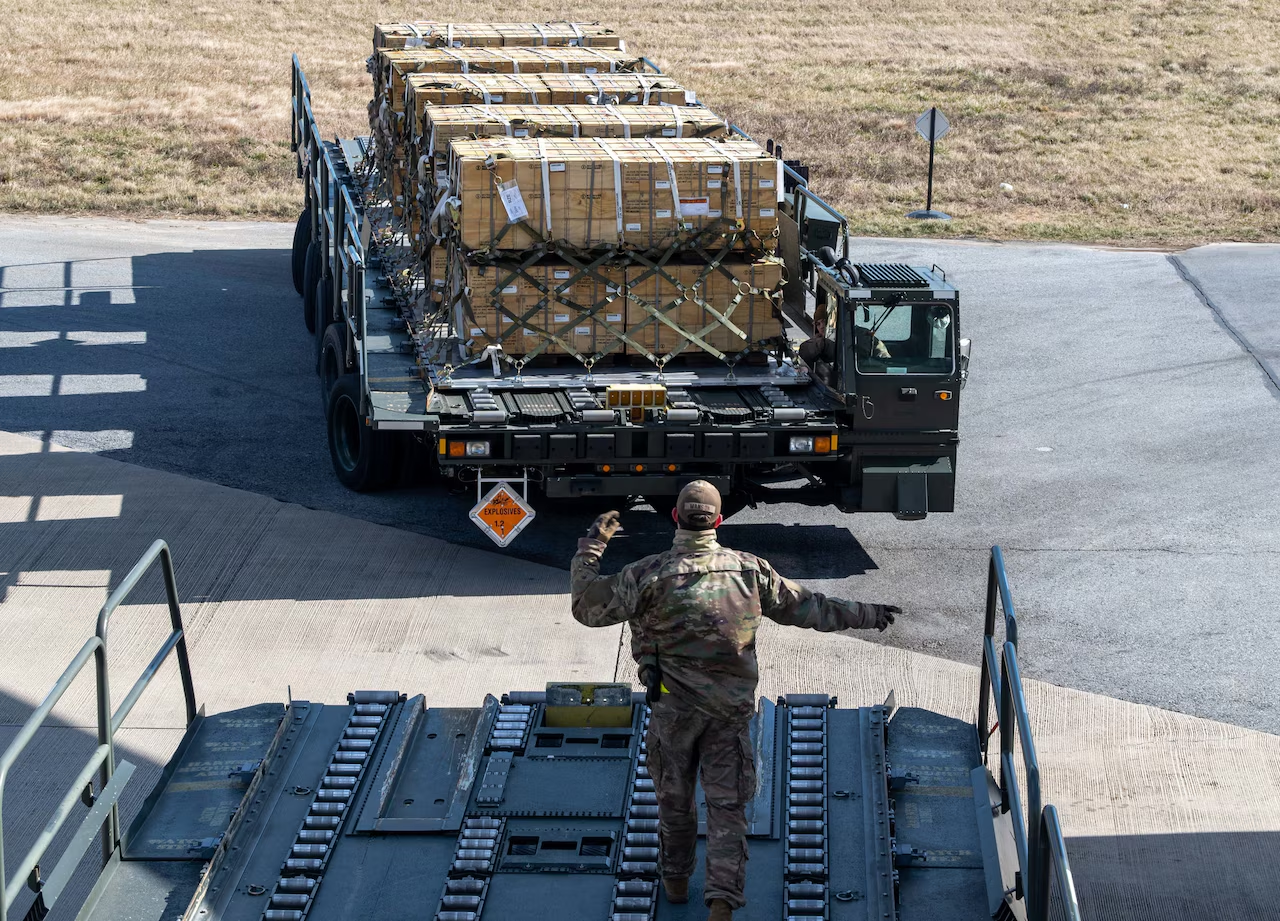
Given the dynamism of the Russian military machine and the huge amount of human resources at Russia’s disposal against Ukraine, our state feels the constant need to strengthen its defence capabilities. Our partners have powerful, modern weapons systems that could protect all Ukrainian regions right now.
In the context of armed confrontation with Russia, an adversary far more powerful than us, all external aid makes it possible to protect towns and villages, save human lives and preserve infrastructure, and liberate occupied territories. Western aid has a direct impact on the lives of soldiers and civilians in Ukraine. Delaying this aid means another victim, another occupation, another destruction of infrastructure.
We desperately need air and missile defence systems to secure the major cities and border areas that receive daily salvos of Russian missiles.
We desperately need effective missile and drone defence systems to safeguard critical infrastructure, as Russian air campaigns have destroyed or significantly damaged Ukraine’s largest thermal and hydroelectric power stations.
As a result of Russian bombing, Ukraine has lost more than 9 GW of generating capacity, according to Ukrainian Prime Minister Denis Shymyhal in early June this year.
Russia is deliberately creating catastrophic living conditions for the Ukrainian civilian population, particularly in the run-up to winter.
We desperately need technological solutions to protect us from the guided aerial bombs that Russia is using to destroy Kharkiv and our other towns close to the front line.
The more systematic and significant the help from Ukraine’s partners, the better the chances of stopping the Russian invasion. This is necessary both for Ukraine and for the West, for the sake of everyone.
AB
How do you analyse the current balance of power between Ukraine and the Russian Federation, which is on the offensive, and how can Ukraine counter and defeat the Russian Federation?
OM
We start from the fact that Russia is much bigger than Ukraine, both in terms of territory and resources. The Russian concept of war is based on the use of considerable human and material resources. This takes the form of mass-produced missiles, artillery barrage and cannon fodder launched against Ukraine.
We have seen these principles of Russian military strategy applied at the front throughout the war. The Russians have everything at their disposal: elite marine infantry units, motorised brigade units and assault battalions made up of prisoners…
Ukraine does not have such human resources and is therefore reluctant to suffer major losses. Nor can we lose territory. Losing even a single town is problematic for the legitimacy of our state. In Russia, the loss of an entire region may not be noticed.
In such a situation, Ukraine is left with the choice of a high-tech asymmetric war in which its aim is to destroy the bases of the Russian army and defence complex.

The example of the Black Sea fleet shows the significant results of this asymmetric warfare strategy. Russia has even lost its flagship to naval drone strikes, not to mention the large amphibious ships and other vessels of the Russian navy.
It seems that such tactics are also effective in destroying Russian military installations, from which missiles are launched in particular.
The efficiency of asymmetric warfare could be considerably increased if Ukraine’s partners were to supply powerful weapons in good time and step up sanctions, particularly against the Russian military and industrial complex.
The key to Ukrainian victory lies in interaction with its partners and in mastering the art of 21st century warfare.
AB
You are a specialist in relations between France and Ukraine, particularly in geopolitical and defence matters. Can you summarise for us the major phases in this relationship since independence in August 1991 and what is the state of cooperation between our two countries today ?
OM
It’s difficult to accurately assess the state of Franco-Ukrainian relations prior to 1991, because at that time France was an independent state, a fully-fledged player in international law, whereas Ukraine was a Soviet Republic within the USSR, which therefore had a totally different status. In other words, at that time, most French people saw Ukrainians as citizens of the USSR.
According to the former French ambassador to Ukraine, Philippe de Suremain, the problem that traditionally underpinned relations between Kiev and Paris was that, for some French politicians, Ukrainian independence was just an “accident of history”. French President Valéry Giscard d’Estaing, for example, said that Ukraine was to Russia “what the Rhône-Alpes region [was] to France”. And this factor has had a certain influence on the formation of Franco-Ukrainian bilateral relations, and has also been felt in conversations with certain French researchers and diplomats. On the other hand, Ambassador Philippe de Suremain, when asked by his colleagues why he really wanted to work in Ukraine, gave a laconic but very precise answer: “you only have to look at a map of Ukraine to understand its importance for Europe”.
Ukraine’s independence contributed to the formation of France’s relations with Ukraine at inter-state level. Over the thirty years of Ukraine’s independence, a generation of Ukrainians has emerged who have not experienced life under the Soviet system, and this generation no longer carries the Soviet mentality. What’s more, for young people in France, Ukraine’s presence on the political map of Europe has become a regular occurrence, and young people are less concerned with historical ‘myths’ than with discovering modern Ukraine. Soon it will be these young people, today’s students, tomorrow’s politicians and diplomats, who do not think through the prism of historical stereotypes, who will define bilateral relations.
In the evolution of Franco-Ukrainian relations, it is important to remember the painstaking daily work of French and Ukrainian diplomats in developing bilateral relations. To a certain extent, it is they who will determine whether these relations will remain solely at the level of political declarations, or whether they will develop into cooperation between the two States in many areas. For example, former scholarship holders from French university cooperation programmes are now working in Ukrainian public institutions, private institutions and French companies in Ukraine. On the other hand, former Ukrainian scholarship holders from French scientific programmes, post-doctoral students, are continuing scientific cooperation with French scientific structures as experienced researchers. In this way, Ukrainian science is gradually becoming an integral part of European science. The European Union’s desire to set up research teams from different countries will only intensify this process.
The most significant events in Franco-Ukrainian relations since 1991.
27 December 1991: France recognises Ukraine’s independence.
5 December 1994: Note verbale from France, reiterating the commitments of the Budapest Memorandum, accompanied by a letter from French President François Mitterrand.
2-4 September 1998: French President Jacques Chirac visits Ukraine (a perfect illustration of the expression “better to see once than hear a hundred times”).
2005: EU citizens no longer require a visa to enter Ukraine.
2014: introduction of the Normandy format.
2017: abolition of the visa regime for Ukrainians holding biometric passports wishing to travel to the European Union.
Last but not least, France is currently helping Ukraine during the invasion of Russia.

It’s interesting that Emmanuel Macron, under fire in 2022 for his telephone conversations with his Russian counterpart that sparked a high-intensity war on Ukrainian soil, then unexpectedly became the first President of the Republic to have refined a long-term French strategy towards Ukraine.
This strategy is based on the following three pillars: firstly, support for Ukraine in obtaining candidate status for the European Union and the implementation of reforms in Ukraine to become a full member of the EU; secondly, a position favourable to Ukraine’s future entry into NATO once the right conditions have been met; Finally, the creation of a French team for the reconstruction of Ukraine under the leadership of Pierre Heilbronn, special envoy of the President of the Republic, a mission that is already operational in the face of current challenges, since it is already able, for example, to direct French assistance towards the urgent reconstruction of Ukrainian hospitals destroyed by the war and to help respond to the problems facing the Ukrainian energy infrastructure as a result of targeted Russian bombing campaigns. We might add that Pierre Heilbronn was quick to perceive Ukrainian advances in the field of digitisation and the possibility for France to take up this Ukrainian know-how. In fact, it’s not just a question of a French assistance policy, but also of defining areas for a mutually beneficial partnership.
In September 2023, Jean-Louis Bourlanges, Chairman of the French National Assembly’s Foreign Affairs Committee, said in an interview for my book: “Ukraine needs friends and help, not undertakers. In reality, in the context of a high-intensity war being waged against a superior adversary, Ukraine’s priority is to survive as a sovereign state and nation. Aid from our European partners is essential for the Ukrainian state to function. This is why Ukrainians are wondering whether President Macron’s strategy towards their country will be maintained if there are significant changes in the balance of power in the National Assembly.
In my humble opinion, the leaders of the Rassemblement National (RN) in France should visit Ukraine not to talk to politicians, but above all to find out about day-to-day reality from ordinary Ukrainians. Why not visit the suburbs of Kyiv and see for herself the war-torn communities. Ms Le Pen could talk to children during a lesson in an underground school shelter, discussing the challenges of everyday life with displaced Ukrainian families. Mr Jordan Bardella, younger than independent Ukraine, could talk to academics and understand why my colleagues, history professors at Shevchenko University, who are not subject to mobilisation, volunteered to risk their lives at the front. Who knows, perhaps the experience of the Ukrainian reality would help to make all French politicians understand that the strategy courageously initiated by President Macron towards Ukraine deserves to be pursued in the short, medium and long term, whatever the tendencies of French politicians. This would send a strong signal from the French political class to the leaders and people of Ukraine.

AB
On 11 and 12 June, the third international conference on the reconstruction of Ukraine was held in Berlin. Is this the right time, is it possible to start rebuilding now ? In your opinion, is it a necessity, a symbol, a necessary perspective ?
OM
Any international summit in support of Ukraine is an urgent necessity, a symbol of solidarity and a prospect for the country’s future recovery and development.
The Ukraine Recovery Conference (URC2024), held in Berlin on 11 and 12 June 2024, was no exception.
We really needed a strategy for the development of our country, and all the more so as negotiations on Ukraine’s accession to the EU begin on 25 June.
The renewed pursuit of war brings with it considerable risks and challenges, particularly in the energy sector. Russia is destroying Ukraine’s electricity production system and other critical infrastructure, endangering the lives and health of millions of citizens as winter approaches. In fact, this is psychological pressure exerted on a Ukrainian population without electricity, water or heating. In this context, help from our partners is not only important, but vital.
From a symbolic point of view, the Berlin Conference was also important. After all, we were convinced of the intention of our partners to continue to support Ukraine, not only in words, but also by creating the conditions necessary for the integration of our State into the European Union and the processes of globalisation. It is no coincidence that the Conference slogan was: “United in defence. United in recovery. Stronger together.
Ukraine aspires to technological development, which is why the emphasis placed by conference participants on innovative infrastructure projects, the implementation of which will make our country a player in economic and technological change on the continent, was welcome.
The main objective of the Conference was to “consolidate ongoing international support for Ukraine’s recovery, reconstruction, reform and modernisation. This includes emergency aid to meet vital needs, the implementation of development projects, the creation of attractive conditions for businesses and investors, and the active participation of civil society in the reconstruction process.
Over a billion dollars have been allocated under the G7+ Coordination Group to help Ukraine’s energy sector. The meeting of this group also took place during the Conference.
The approach of creating attractive conditions for business and investors and developing civic initiatives has proved invaluable, as it allows us to think about Ukraine’s long-term development and does not just respond to the immediate needs of a country at war.
It is therefore wrong to consider that the date of the conference was poorly chosen because the Peace Summit was held in Switzerland on 15 and 16 June, very close together. In fact, the two events are closely linked. The aim of the summit was to find a political model for achieving a just peace, while the conference on the restoration of Ukraine was to find a model for Ukraine’s economic development that would enable it not only to recover as quickly as possible, but also to integrate into the processes of European and global economic integration. It is no coincidence that the Conference was held as both an intergovernmental meeting and a stimulus forum.
More than 2,000 people from over 60 countries around the world took part in the Conference. A total of 110 international agreements were signed, worth a total of €16 billion, according to Germany.
This conference, which Ukraine attended as a candidate for EU membership, has become a practical platform for transforming Ukraine into a stable country. The prospects are not just for the defence sector (and one of the ways of achieving this is the creation of joint ventures for arms production, which was also discussed at the Conference for specific projects), but also for small and medium-sized enterprises and local authorities. For example, projects to support the “Alliance for the Sustainability of Small and Medium-sized Enterprises for Ukraine” project were adopted, with an estimated pledged amount of €7 billion. In terms of volume, the “Guarantee and Grant Agreements under the Investment Component of the Ukraine Facility Programme” with a total amount of 1.4 billion euros constitute the second aid package.
Of course, this will contribute to the economic and social stability of Ukraine and Europe as a whole.
AB
How would you like to conclude this interview ?
OM
I want the war to end.
Ukraine has become a powerful country, with a resilient and innovative economy and a vigorous civil society. It is a full member of the European Community.
I also want all those responsible for the suffering in my country to suffer the punishment they deserve !

Oksana Mitrofanova, Ukrainian politician and refugee in France. Senior researcher at the Institute of World History of the Ukrainian National Academy of Sciences in Kyiv, teacher-researcher hosted as part of the national PAUSE programme for exiled researchers at the Institut national des langues et civilisations orientales (INALCO Paris) from May 2022 to August 2024, author of the book “France-Ukraine. Une histoire des relations diplomatiques et militaires. 1991-2023” (Fondation Maison des Sciences de l’Homme, 2024). Throughout my professional life I have worked at the Ukrainian National Academy of Sciences (the counterpart of the National Centre for Scientific Research), specialising in French and Ukrainian foreign and security policy and Franco-Ukrainian relations.
Visiting lecturer at the University of Paris-Panthéon-Assas, three times senior visiting researcher at the Maison des Sciences de l’Homme, Paris, visiting researcher at the Marie Curie-Sklodowska University, Lublin, Poland. With a doctorate in political science, I am the author of over 100 publications and analytical notes for the Ministry of Defence, the Ukrainian Ministry of Foreign Affairs and the Ukrainian Parliament, and a speaker at international conferences in Budapest, Indianapolis, Kyiv, Lisbon, Lviv, Paris and Warsaw. A native Ukrainian and Russian speaker, Oksana Mitrofanova is also fluent in English, French and Polish. A regular contributor to LCI, France 24 and the Ukrainian channel Pryamyi. She has published articles in Le Monde and Libération.
 You can order his book by mail order at the following link : France-Ukraine – Éditions de la Maison des sciences de l’homme (editions-msh.fr)
You can also find it in the following bookshops :
Librairie Les Belles lettres – 95 bd Raspail, 75006 Paris
Librairie L’Ecume Des Pages – 174 bd St Germain, 75006 Paris
Librairie Tschann –


 Pierre Brunet is a novelist and a member of the Board of Directors of the NGO SOLIDARITES INTERNATIONAL. He became involved in humanitarian work in Rwanda in 1994, then in Bosnia in 1995, and has since returned to the field (Afghanistan in 2003, the Calais Jungle in 2016, migrant camps in Greece and Macedonia in 2016, Iraq and north-eastern Syria in 2019, Ukraine in 2023). Pierre Brunet’s novels are published by Calmann-Lévy: “Barnum” in 2006, “JAB” in 2008, “Fenicia” in 2014 and “Le triangle d’incertitude” in 2017. A former journalist, Pierre Brunet regularly publishes analytical articles, opinion pieces and columns.
You must be logged in to post a comment.