Humanitarian aid, 31 billion in 2020

Launching a nutrition campaign in Southern Sudan with UNICEF and WFP, 2015. Credit: UN Photo/JC McIlwaine (CC BY-NC-ND 2.0)

Official Development Assistance figures for 2020 are now available.

2020 ? For humanitarian operators used to immediacy, releasing figures for 2020 mid-2022 may seem laughable. More immediate data can be found elsewhere, such as OCHA’s Financial Tracking System (FTS).

But the OECD is not working on immediacy, rather on the quality and comparability of data between countries. Each of the thirty members of the Development Assistance Committee (DAC) reports each development assistance project to the OECD, and each of these data, for each contract signed, is analyzed to ensure that the expenditure corresponds to the definition of Official Development Assistance (ODA). This is an immense task, which has ensured the integrity of ODA figures since its creation in 1969. Humanitarian assistance is one part of ODA among many others, and even if definitions adapt, it is generally over time that one must read these figures.

2020, then. The Covid pandemic was just beginning. The United Nations was appealing for $9.5 billion in funding, while many humanitarian operations were frozen. Ukraine was only the 26th recipient of UN humanitarian funds, and many questions arose. Why was so much money requested if so many programs were blocked? What was going to happen, would donors divert their aid budgets to an economic and social response at home? Not so, and total ODA increased again in 2020, from $196 billion in 2019 to $224 billion in 2020. 60% of this amount comes from the 30 DAC members. Preliminary figures for 2021 already suggest a further increase.

For donors, humanitarian aid spending is a part of Official Development Assistance. In 2020, DAC members’ share of humanitarian aid amounts to $31.2 billion. This represents 13% of total ODA. Logically, since it is in these contexts that humanitarian aid is mobilized the most, the humanitarian share represents 25% of aid in fragile countries. This is an average and the share of humanitarian aid varies greatly from one country to another (Table 1). Less than 1% of French ODA is allocated to humanitarian aid, a decline since 2019, while more than 28% of US aid is humanitarian. The overall trend is upward, therefore, for humanitarian aid (Figure 1).

Source : OECD Creditor Reporting System, Creditor Reporting System (CRS) (oecd.org)

In 2020, 43% of this humanitarian aid was delivered in the Middle East and North Africa region and 26% in sub-Saharan Africa. This is reflected in the share of “non-traditional” donors, i.e., those that are not part of the Aid or Development Committee and do not follow its rules. These are mainly donors from the Gulf and Turkey, whose aid is targeted more precisely at specific crises, Syria in particular and Yemen next, with greater annual variations and therefore less predictability. (Figure 2). It is not clear that the share of non-DAC donors funding aid to Ukraine, or that they are making up for the share of DAC members’ aid to Ukraine that does not go to other crises.

Source : OECD Creditor Reporting System, Creditor Reporting System (CRS) (oecd.org)

In 2020, 33% of this humanitarian aid will be implemented by international or national NGOs. Although the aid distributed by NGOs is increasing in absolute value, with 6.4 billion dollars in 2020, the percentage is tending to decrease over the long term; it was 41% in 2002. For NGOs, this is an effect of the general increase in humanitarian aid, which tends to favor large allocations to those who can best absorb them. For a donor that is bound by budgetary rigor and limited staffing, absorption capacity also includes its own administrative capacity to issue contracts, and this capacity is only decreasing, to the detriment of NGOs and even more so of national NGOs. Figure 3)

Source : OECD Creditor Reporting System, Creditor Reporting System (CRS) (oecd.org)

The growing share of humanitarian aid in absolute terms as well as in percentage of aid raises several questions. An important element of the discussions is that this continuous increase in needs, and therefore in humanitarian funding, is not sustainable in the long term, especially since there will always be more needs than funding to meet them. Crises are less deadly than a few decades ago, but there are more of them, and it is therefore normal that the pressure on humanitarian assistance increases accordingly. Crises also seem to be getting more expensive. The United Nations flash appeal for Ukraine is asking for $2.25 billion for a six-month operation in a region without major logistical problems. That’s more than $12 million a day, plus the response of neighboring governments, led by Poland, to accommodate the refugees. To compare, the five-year war in Bosnia between 1991 and 1995 cost its main humanitarian operator a little over a billion dollars at the time – about two billion today.

Compared to the 57 most fragile countries, humanitarian aid, which represented 11% of total aid in 2002, now represents 25%. What does this growth in the humanitarian sector tell us?

Most of this aid is mobilized in conflict contexts. This trend partly reflects the impossibility for the “international community” to prevent conflicts, or at least to transform conflicts into violence. As we see more and more every day, the list of common values that underpinned the concept of international community is rapidly eroding. The United Nations is no longer able to play the role that justified its creation – preserving peace – and, as a powerless spectator of a changing world, the organization has thus turned into a giant humanitarian organization. The war in Ukraine, unexpectedly, plays the role of an earthquake that suddenly releases years of accumulated geopolitical tensions, and we are probably not finished suffering the aftershocks.

Cyprien Fabre

PS/ Your donation (make a donation) allows us to publish and develop Humanitarian Challenges, a free and independent website. Thank you for your support.  

Cyprien FABRE

Cyprien Fabre is the Head of the Crisis and Fragility Unit at the OECD. After several years of humanitarian missions with Solidarités, he joined ECHO, the European Commission’s humanitarian department in 2003, and held several positions in crisis contexts. He joined the OECD in 2016 to analyze the engagement of DAC members in fragile or crisis countries. He also wrote a series of “policy into action” and then “Lives in crises” guides to help translate donors’ political and financial commitments into effective programming in crises. He is a graduate of the Faculty of Law of Aix-Marseille.


Tableau 1 : Official Development Assistance 2020 and Humanitarian Aid

million of dollars 2020, Gross ODA, disbursement

Membre du Comité d’Aide au Développement Aide Publique au Développement 2020 (USD million) Aide humanitaire 2020 (USD million) Part d’aide humanitaire de l’APD totale (%)
Total CAD 152 895.09 19 775.44 12.93
Australie 2 318.95 232.88 10.04
Autriche 568.21 55.68 9.8
Belgique 1 175.95 186.89 15.89
Canada 3 917.17 578.87 14.78
Republic Tcheque 72.7 19.03 26.18
Danemark 1 718.5 368.49 21.44
Institutions UE 23 977.1 2 534.8 10.57
Finlande 656.94 90.8 13.82
France 13 088.23 124.29 0.95
Allemagne 25 878.79 1 961.46 7.58
Grèce 84.78 4.21 4.96
Hongrie 225.93 7.65 3.39
Islande 46.13 4.03 8.74
Irelande 521.95 123.24 23.61
Italie 1 403.01 173.29 12.35
Japon 16 886.07 451.19 2.67
Korée 1 925.23 1925.23 6.76
Luxembourg 314.81 61.07 19.4
Pays-bas 3 748.29 342.58 9.14
N.Zélande 433.41 27.33 6.31
Norvège 3 168.32 473.12 14.93
Pologne 233.06 37.07 15.9
Portugal 230.37 6.18 2.68
Répubique Slovaque 37.35 1.4 3.74
Slovénie 31.15 1.82 5.83
Espagne 1 036.17 111.61 10.77
Suède 3 618.25 551.05 15.23
Suisse 2884.7 589.4 20.43
Royaume Uni 12 381.1 12 381.1 15.86
U.S. 30 312.46 8 562.12 28.25


Source : OECD Creditor Reporting System, Creditor Reporting System (CRS) (oecd.org)


Humanitarian innovation tested in the field: the example of the Orisa water purifier

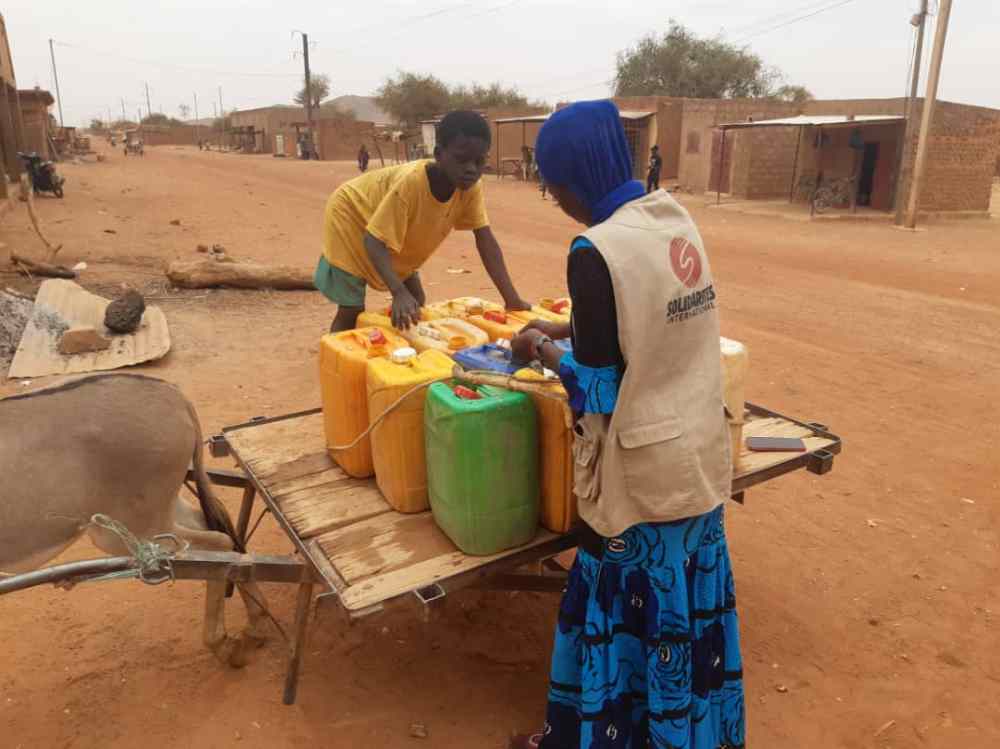
Photo taken in Djibo by Sebastien Batangouna Banzouzi, WASH site manager at SOLIDARITES INTERNATIONAL in Burkina FASO @SOLIDARITES INTERNATIONAL

Humanitarian action is made up of commitment and concrete responses, without which it is only words. In order to provide these responses in an efficient manner, and to meet the needs of the people being helped, innovative technical solutions play a decisive role, multiplying the time saved, the number of people assisted, and the impact of the aid. This notion of innovation is present in all areas of our work (food security, health, shelter, resilience, etc.), and of course in the technical area of WASH (water, hygiene and sanitation).

The paradigm shift sometimes consists, without revolutionizing the technical solution itself, in providing actors and beneficiaries in the field with an easy-to-use, reliable response adapted to the entire spectrum of interventions, from emergency to development, in terms of individual, family or collective access to safe drinking water. This is the idea behind the Orisa water purifier proposed by Fonto De Vivo, a company co-founded by Anthony Cailleau, a specialist in R&D, and David Monnier, a former humanitarian who has worked for 14 years in a variety of difficult areas: Liberia, Iraq, Comoros, Guinea, Afghanistan… He was able to measure the need for easy and safe means of access to water for populations impacted by security, climate or epidemic crises. The development of the Orisa purifier was done, starting in 2017, in partnership with researchers from the universities of Nantes (where Anthony Cailleau and David Monnier met, and decided to found Fonto De Vivo) and Vendée. A focus group of six French NGOs was set up to specify their needs in terms of purification and related logistics. Then a design firm in Nantes and a design office in Vendée specialized in plastics finalized the product, which started to be marketed in 2021.

In concrete terms, it is a portable and autonomous purifier, modest in size (42.5 x 17 x 12cm), weighing 2.1 kg, operating by manual pumping, intuitive, and conforming to the quality guidelines for drinking water of the WHO. The ultrafiltration is done by hollow fiber membranes through which the water passes. The purifier is adaptable to different types of containers, tanks, and treats surface water (wells, streams…).

The test bed for a tool intended for humanitarian use is its implementation in the field. In this respect, the intervention carried out by the NGO SOLIDARITES INTERNATIONAL in Djibo, Burkina-Faso (emergency program), is significant, as for the potential of the Orisa purifier. The particular context of the town of Djibo, which is under blockade by armed groups, has transformed a critical situation into a humanitarian emergency. Even before the blockade, Djibo was affected by the increasing scarcity of water resources due to climate change, and was home to a large number of displaced persons in the Sahel. As of March 31, 2002, according to the Burkinabe government agency that registers internally displaced persons, there were 283,428 displaced persons in Djibo, out of a resident population of approximately 50,000. In January, armed groups forcibly displaced people from surrounding villages; according to OCHA, 36,532 people arrived in less than two months. The tension on drinking water resources was at its highest. Then the blockade was declared on February 17, laying mines on the access roads and attacking any vehicle or person attempting to enter or leave the town. Finally, armed groups sabotaged water points and water access infrastructure between February 21 and March 13: destruction of a generator in the Office National de l’Eau et de l’Assainissement network (which supplied 2/3 of the population), two of the three generators supplying the pumping stations serving the public network (reducing water production by 80%), and six of the twelve solar-powered adductions, put out of service by shooting at the storage tanks… According to estimates by the WASH cluster, at least 220. According to WASH Cluster estimates, at least 220,000 people have lost access to protected water sources as of 3/17/2022 due to these attacks. The population of Djibo, as Sébastien Batangouna, EHA SOLIDARITES INTERNATIONAL site manager in Burkina Faso, recounts, “was reduced to digging makeshift holes in the dry dam bed by hand, extracting insufficient quantities of murky water, or to drawing from a few wells or stagnant surface water. In addition, there have been numerous attacks on people collecting water. Access to water has become an issue of pressure on the population for armed groups.

Photo taken in Djibo by Sebastien Batangouna Banzouzi, WASH site manager at SOLIDARITES INTERNATIONAL in Burkina FASO @SOLIDARITES INTERNATIONAL

In this context, and in a city that is only connected by helicopter to the rest of the country, the traditional WASH responses, as explained by Lise Florin, WASH Coordinator at SOLIDARITES INTERNATIONAL in Burkina Faso, are no longer adapted: “Too dangerous to repair vandalized water points and generators, water-trucking unthinkable because water points inaccessible and fuel supply limited by the blockade, installation of bladders (flexible tanks) ruled out, because a treatment station would have been too visible and pumping difficult in makeshift holes, finally limited access to the dam for security reasons.” The only remaining solution was to treat homes and/or communities, using unconventional water sources (surface water scattered throughout the city) if necessary. A “discreet” and safe solution, therefore, which consisted in “diverting”, to use the words of Baptiste LECUYOT, Head of the EHA – Technical Expertise and Quality of Programs Unit at SOLIDARITES INTERNATIONAL headquarters, “the use of purifiers normally more suitable for home water treatment, by setting up collective filtration points where people would come to fetch filtered water, without having to set up larger facilities“. 242 community volunteers were recruited and trained, 64 filtration points were set up, and a mobile team of 50 volunteers was assigned to go out and educate households on hygiene and home water treatment. To date, 500 Orisa purifiers have been deployed in Djibo by SOLIDARITES INTERNATIONAL.

Even if the intervention of SOLIDARITES INTERNATIONAL in Djibo is still ongoing, we can already see that, as Sebastien Batangouna points out, “The handling, use, maintenance and repair of the Orisa purifiers has been easy, as has the training of the national staff and day laborers. This simplicity was reinforced, as Lise Florin reminds us, “by the tutorials made available on the Internet by Fonto De Vivo“. Lise Florin adds that, in addition to their discretion and simplicity, “these purifiers have proven to be faster than the chemical “PUR” treatment: between 120 L/H and 180 L/H for ORISA filters, compared to 40 L/H for PUR. Also less voluminous: 4 times less 20L buckets are needed to cover the same number of beneficiaries, transportation and storage are therefore easier and less expensive. Finally, the water is of better quality for the people rescued, because it is simply chlorinated after filtration to avoid recontamination of the water during transport/storage. In Djibo, these purifiers have been used intensively, from 4 to 6 hours a day, producing about 100 L/H each, or 4 days’ worth of water for a “normal” family. Of course, pumping requires a minimum of physical strength, but given the context and the emergency, this response proved to be the most relevant, efficient and discreet. It should be mentioned, however, that non-compliance (related to a supplier) was found in Djibo, on a number of Orisa purifiers. The problem was immediately recognized by Fonto De Vivo, which implemented solutions, as the purifiers were repairable: new parts (rings) were tested and sent to Burkina Faso by express mail; and, in addition to the stock of membranes already on site, new ones are being sent to replace those that had a problem (with the remote support of Fonto De Vivo, and knowing that these membranes must be changed anyway after a certain time of use)

SOLIDARITES INTERNATIONAL (which had already used the Orisa purifier in Niger in a limited way in health centers), has also deployed it in Haiti in schools, and plans to use it in Mali for emergency response. Allassane Traore, EHA Dakar coordinator, emphasizes that this tool is interesting “for interventions with transhumant populations or those affected by recurrent displacements, often forgotten by humanitarian responses and particularly at risk when it comes to access to drinking water.

@MSF, Madagascar, avril 2022

In addition to SOLIDARITES INTERNATIONAL, other NGOs use the Orisa purifier, such as MSF in Ukraine (in health care facilities) and in Madagascar (with communities). Its very good bacterial (99.999999%, i.e. LOG 8) and viral (99.999%, i.e. LOG 5) filtration performances make it an obvious infection prevention tool, but, as Jérôme Leglise, Water and Sanitation Referent at MSF’s Operational Support Pole, points out, a specific technical innovation was of particular interest to MSF: its backwashing system using purified water, limiting contamination during washing. The medical NGO considers this purifier to be particularly suitable for exploratory missions, small bases or isolated health structures, specific communities far from urban networks, and people at risk (pregnant women, immunocompromised people, young children, measles cases) in a post-consultation or hospitalization “discharge kit”.

Finally, the CDCS (Crisis and Support Center of the Ministry of Europe and Foreign Affairs) has ordered 405 Orisa purifiers, in order to build up a contingency stock to respond to potential emergencies (natural disasters, conflicts, pandemics…).

In the end, this tool shows that, between the challenge of developing a product and the test of the field, humanitarian innovation is – also – a form of risk-taking… necessary…

Pierre Brunet

Writter and Humanitarian


To go further : 


PS/ Your donation (make a donation) allows us to publish and develop Humanitarian Challenges, a free and independent website. Thank you for your support.  

Born in 1961 in Paris to a French father and a Spanish mother, Pierre Brunet found his first vocation as a freelance journalist. In 1994, he crossed paths with humanitarian aid and volunteered in Rwanda, which had been devastated by genocide. In early 1995, he left on a humanitarian mission in Bosnia-Herzegovina, then torn by civil war. There he took on the responsibilities of program coordinator in Sarajevo, then head of mission.

Upon his return to France at the end of 1996, he joined the headquarters of the French NGO SOLIDARITES INTERNATIONAL, for which he had gone on mission. He will be in charge of communication and fundraising, while returning to the field, as in Afghanistan in 2003, and starting to write… In 2011, while remaining involved in humanitarian work, he commits himself totally to writing, and devotes an essential part of his time to his vocation of writer.

Pierre Brunet is Vice-President of the association SOLIDARITES INTERNATIONAL. He has been in the field in the North-East of Syria, in the “jungle” of Calais in November 2015, and in Greece and Macedonia with migrants in April 2016.

Pierre Brunet’s novels are published by Calmann-Lévy:

  • January 2006: publication of his first novel “Barnum” by Calmann-Lévy, a story born from his humanitarian experience.
  • September 2008 : publication of his second novel ” JAB “, the story of a little Spanish orphan girl who grew up in Morocco and who will become a professional boxer as an adult.
  • March 2014: release of his third novel “Fenicia”, inspired by the life of his mother, a little Spanish orphan during the civil war, refugee in France, later an anarchist activist, seductress, who died in a psychiatric institute at 31 years old.
  • End of August 2017: release of his fourth novel “The Triangle of Uncertainty”, in which the author “returns” again, as in “Barnum” to Rwanda in 1994, to evoke the trauma of a French officer during Operation Turquoise.

In parallel to his work as a writer, Pierre Brunet works as a co-writer of synopses for television series or feature films, in partnership with various production companies. He also collaborates with various magazines by publishing columns or articles, particularly on international news.